Ear Piercing Aftercare – Complete Guide 2026
Getting your ears pierced is just the beginning – the real work starts afterward. Proper aftercare determines whether your piercing heals quickly without issues, or whether you'll experience redness, swelling, or infection.
In Warsaw, myths still circulate about "twisting earrings," using alcohol, and hydrogen peroxide. Meanwhile, modern aftercare standards are simpler and more effective – just a few basic steps that take a few seconds each day.
This guide is based on practical experience with children and adults, as well as recommendations from medical ear piercing system manufacturers.
First 24 Hours – What to Do
In the first day after piercing, your body reacts to the wound. This is normal. You may notice slight redness, minor swelling, or a throbbing sensation in your ear. These are signs that your immune system is working.
What to do:
- leave the earrings alone – don't touch, turn, or move them
- don't wash your hair by pulling clothes over your head (to avoid snagging)
- change your pillowcase to a fresh, clean one
- if swelling appears, apply a cold compress through clean gauze for 10 minutes
- sleep on the other side or on your back
What to avoid:
- touching your ear with dirty hands
- submerging your head in water (bath, pool)
- wearing over-ear headphones
- washing your hair (if possible, wait 24 hours)
The first 24 hours are the most intensive healing period. Calm and minimal interference work best.
Week by Week – What to Expect (6-8 Weeks)
Piercing healing is a gradual process. Not all weeks look the same.
Week 1-2: Tissue is sensitive. You may notice minor swelling, slight redness, or dry skin around the earring. This is normal – your body is building a new channel. During this time, regular hygiene and avoiding disturbance (no touching, no turning) are most important.
Week 3-4: Tissue stabilizes. Redness should subside, swelling disappears. Your ear looks almost normal, but the channel inside is still forming. This is the most common time when people prematurely remove earrings – that's a mistake. Even if it looks good externally, the piercing isn't ready.
Week 5-6: The channel stabilizes. Epithelial tissue covers the inside of the piercing, sensitivity decreases. After a full 6 weeks (for lobe), you can consider changing earrings – according to official Inverness Med instructions.
After 6 weeks (lobe) / 12 weeks (cartilage): You can safely change earrings. Remember, though, that full healing takes about a year – during this time, choose lightweight, hypoallergenic, nickel-free earrings (like the BIOJOUX line) to avoid irritating still-stabilizing tissue.
Important: cartilage heals longer – usually 12 weeks (3 months). For helix, flat, conch, or tragus, aftercare takes longer, and earrings can only be changed after the full healing period.
What to Clean With – Products and Step-by-Step Instructions
The key to proper aftercare is simplicity. You don't need many products – three options are enough.
Best Solutions for Piercing Aftercare
1. Ear Care Solution (Inverness Aftercare) – Recommended
This is the official aftercare solution for the Inverness Med piercing system. It's dedicated to fresh piercings, contains ingredients that accelerate healing and minimize infection risk. Tested by the manufacturer for hypoallergenicity and effectiveness. Available at Gentle Piercing salon.
2. Saline Solution 0.9% (NaCl)
Available at any pharmacy. Natural, safe, doesn't irritate tissue. You can buy a bottle or single-use packets. Saline works mechanically – it rinses out contaminants without disrupting the natural healing process.
3. Boiled Water with Sea Salt
A home option if you don't have access to a pharmacy. Dissolve ¼ teaspoon of non-iodized sea salt in 250 ml (1 cup) of boiled, lukewarm water. Use the same day.
What NOT to use:
- alcohol (dries tissue, delays healing)
- hydrogen peroxide (destroys healthy cells)
- Octenisept (too strong for fresh piercings)
- cosmetics with added fragrances
- antibiotics without a doctor's prescription
How to Properly Clean a Piercing – Instructions
Frequency: 3 times daily (morning, midday, and evening) according to Inverness Med manufacturer instructions.
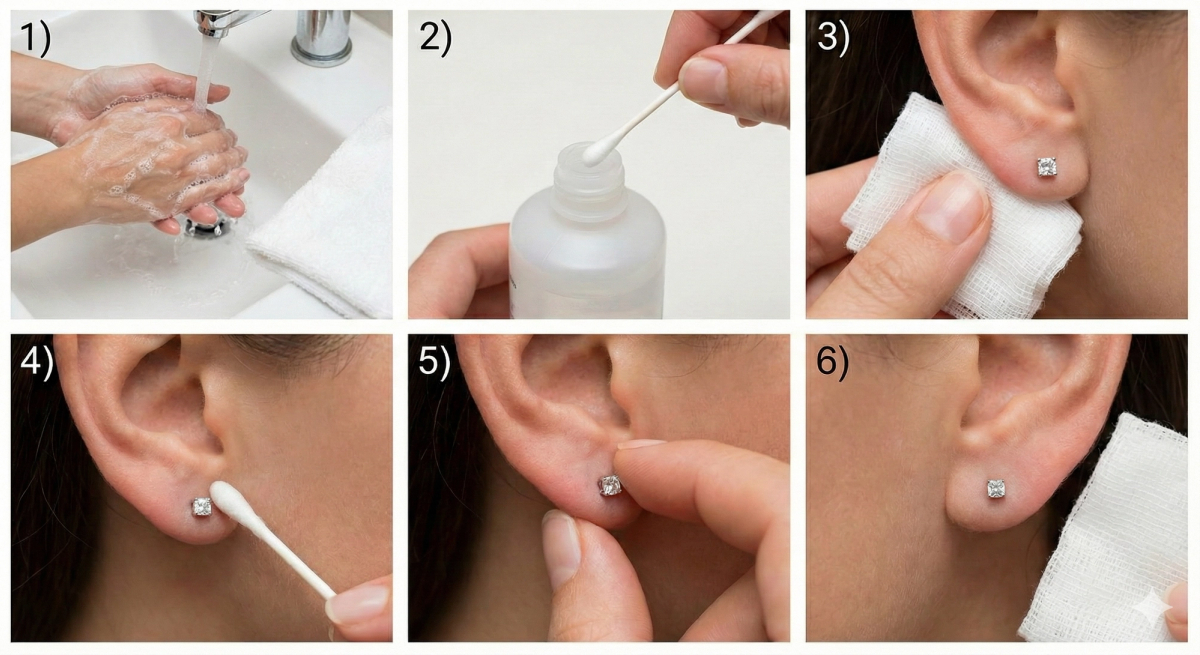
Step 1: Wash your hands thoroughly with soap for at least 20 seconds. Dry them with a clean towel.
Step 2: Moisten clean gauze, a cotton swab, or cotton with aftercare solution (or saline).
Step 3: Gently press the moistened gauze to the front and back of the piercing. Hold for 30-60 seconds – the solution works to soften any dried discharge.
Step 4: Gently wipe the earring and surrounding skin – remove discharge, dirt, dry skin. Don't rub hard. No twisting the earring.
Step 5: After cleaning, gently rotate the earring left and right by 180° (half turn). This helps the solution reach inside the channel and prevents tissue from sticking to the earring during healing.
Step 6: Leave to air dry or pat dry with clean, disposable gauze.
Important: don't reuse the same gauze, don't "soak" the ear in solution, don't twist the earring aggressively. These old practices don't speed healing – on the contrary, they irritate tissue.
What to Avoid – Swimming Pool, Sports, Hairdresser
A fresh piercing is an open wound. For the first weeks, the channel is susceptible to infection and mechanical damage.
Swimming Pool and Gym
When can I go swimming after ear piercing?
Not earlier than 6 weeks (lobe) or 12 weeks (cartilage).
Why?
Pool water, even chlorinated, contains bacteria. Chlorine and other chemicals can additionally irritate fresh piercings. Submerging your head in water increases infection risk.
Additional recommendations:
- avoid sauna and tanning beds during healing
- children should avoid sandboxes and playgrounds (bacteria, sand, snagging risk)
- use showers instead of baths
- limit consumption of alcohol, coffee, black tea, and cola (can increase swelling)
If you must swim earlier, you can protect the piercing with waterproof bandages (available at pharmacies), but this doesn't guarantee full protection. It's better to wait.
What about the gym?
Exercise itself isn't a problem. The problems are:
- sweat (irritates tissue, requires additional cleaning)
- touching your ear with dirty hands (after touching gym equipment)
- over-ear headphones (compress the piercing)
If you exercise, wash your ear right after training and don't wear over-ear headphones. In-ear – OK.
Hairdresser and Hair Washing
Hair washing:
For the first 2-3 days, wash your hair carefully. Shampoo can irritate fresh piercings, and rinsing your head can introduce bacteria. Best practice:
- wash hair over a sink, not in the shower (more control)
- avoid shampoo running directly onto ears
- rinse thoroughly
- after washing, gently clean the piercing with saline
Hairdresser:
If you're planning a salon visit in the first weeks, inform them about your fresh piercing. Avoid:
- washing hair lying back over a sink (pressure on ears)
- hairstyles requiring intensive combing around ears
- blow-drying hot air directly on the piercing
When to Change Earrings
Changing earrings too early is the most common cause of problems we see in practice. The channel may look good externally, but internally it's still not fully formed.
Earlobe: earliest after 6 weeks (according to Inverness Med instructions).
Cartilage (helix, flat, conch, tragus): not earlier than 12 weeks (3 months).
Important: full healing takes about a year. After 6-12 weeks you can change earrings, but tissue is still stabilizing – for the first year, choose lightweight, hypoallergenic earrings (like titanium, niobium, nickel-free BIOJOUX).
How to know if the piercing is ready?
- no pain with gentle touch
- no redness
- no discharge or dry skin
- earring moves freely (without resistance)
- no feeling of tissue "pulling"
If you have doubts, wait another week. There's no rush.
How to safely change earrings?
If this is your first piercing, ask for help at a piercing salon or the studio where you had it done. They have sterile conditions and experience.
Removing Inverness earrings: To remove Inverness earrings, firmly hold the Safety Back end, and with your other hand, twist and pull the front of the earring.
If you're changing them at home:
- wash your hands thoroughly
- use earrings made of hypoallergenic materials (titanium, surgical steel, 14-18K gold, or nickel-free BIOJOUX)
- clean both old and new earrings with saline
- insert slowly, without force
- if you feel resistance – stop and return to it in a few days
Signs of Infection – When to See a Doctor
Most piercings heal without problems. But sometimes the body reacts with infection – usually due to contamination, premature earring change, or lack of hygiene.
Normal symptoms in the first days (don't worry):
- slight redness (pink tint around piercing)
- minor swelling
- temporary feeling of warmth or throbbing
- small dry discharge (white or transparent)
Infection symptoms (contact a doctor):
- increasing pain (doesn't subside after a few days, but intensifies)
- intense redness (dark red spreading to a larger area)
- severe swelling (enlarging, making it difficult to pull clothes over your head)
- purulent discharge (yellow, greenish, with unpleasant odor)
- fever above 38°C (100.4°F)
- stiffness or pain when moving your head
What to do if you suspect infection:
- Don't remove the earring – if you close the channel, purulent discharge can stay inside and worsen the condition. This is very important: even if infection or severe inflammation appears, do not remove the earrings.
- Increase cleaning frequency to 4 times daily (EAR CARE SOLUTION or saline).
- Contact a doctor or the clinic where you had the piercing done – dermatological consultation or antibiotics may be needed.
- Keep the area clean, avoid touching.
Allergic reaction vs infection
Sometimes the problem isn't bacteria, but an allergic reaction to the earring metal. Symptoms include:
- itching without pain
- rash around the piercing
- prolonged redness without purulent discharge
In this case, consult a specialist – you may need to replace the earring with titanium or niobium (highest hypoallergenicity level).
If you're interested in earring materials, check out what earrings to choose for first piercing.
→ Ear piercing for children Warsaw
FAQ – Most Common Aftercare Questions
Should I twist the earring so it doesn't grow in?
Yes, but in moderation. Inverness Med manufacturer recommends gently rotating the earring 180° (half turn) during daily cleaning – this helps solution reach inside the channel and prevents tissue from "sticking" to the earring. This differs from the old myth of constant, aggressive twisting several times a day "dry" – that practice actually irritates tissue. Twisting only makes sense during cleaning, with solution, gently.
When can I sleep on my pierced ear?
It's best to wait at least 2-3 weeks. Pressure on a fresh piercing can cause swelling, pain, or earring displacement. If you must sleep on your side, use a travel pillow with a hole in the middle or arrange pillows so they don't press on your ear.
How many times a day should I clean the piercing?
3 times daily – morning, midday, and evening, according to Inverness Med manufacturer instructions. Less frequent cleaning can lead to discharge buildup. The only exception: if you have infection symptoms, a doctor may recommend more frequent cleaning.
Can I use Octenisept drops?
Octenisept is a strong disinfectant used in medicine, but it's not recommended for daily piercing aftercare. It's too strong and can dry out tissue. If a doctor prescribed Octenisept in a specific situation (e.g., after infection), use it as directed. For standard aftercare, saline or special Inverness Aftercare solution is sufficient.
Can I use perfume, hairspray, or cosmetics near the piercing?
For the first 4-6 weeks, avoid products containing alcohol, fragrances, and strong chemicals. They can irritate fresh piercings. When applying hairspray, cover your ear with your hand. Before applying perfume, wait until the piercing heals.
Can I stop aftercare after healing?
After healing (6 weeks for lobe, 12 weeks for cartilage), you don't need to apply special solutions 3× daily anymore. However, remember that full healing takes about a year – during this time, choose lightweight, hypoallergenic, nickel-free earrings (like the BIOJOUX line). It's still worth washing earrings occasionally with saline – especially if you wear them long-term. This prevents dirt and discharge buildup.
When can I go back to swimming?
Not earlier than 6 weeks (for lobe) or 12 weeks (for cartilage). Official instructions recommend avoiding pools, saunas, and tanning beds throughout the entire healing period. If you have doubts, wait another 1-2 weeks. It's better to wait a week too long than risk infection. For children, it's also recommended to avoid sandboxes and playgrounds during this period.
What if the earring falls out before healing?
Don't panic. If the piercing is fresh (first 2-3 weeks), the channel may start closing within a few hours. As quickly as possible:
- wash your hands
- clean the earring with saline
- gently try to insert the earring back
- if it won't go in – don't force it, go to a piercing salon
If the piercing is older (4-6 weeks), you have more time – the channel closes more slowly.
Summary – Simple and Effective Aftercare
Ear piercing aftercare isn't complicated. Three things are enough: cleanliness, patience, and minimal interference.
Most important rules:
- clean 3 times daily with EAR CARE SOLUTION or saline
- after cleaning, gently rotate the earring 180° (half turn)
- don't touch with dirty hands
- wait 6 weeks before changing earrings (lobe) or 12 weeks (cartilage)
- remember: full healing takes about a year
- avoid pools, saunas, tanning beds, and wet environments throughout healing
- watch for infection signs – if they appear, act quickly
If you follow these simple rules aligned with Inverness Med instructions, your piercing will heal calmly and without problems.